


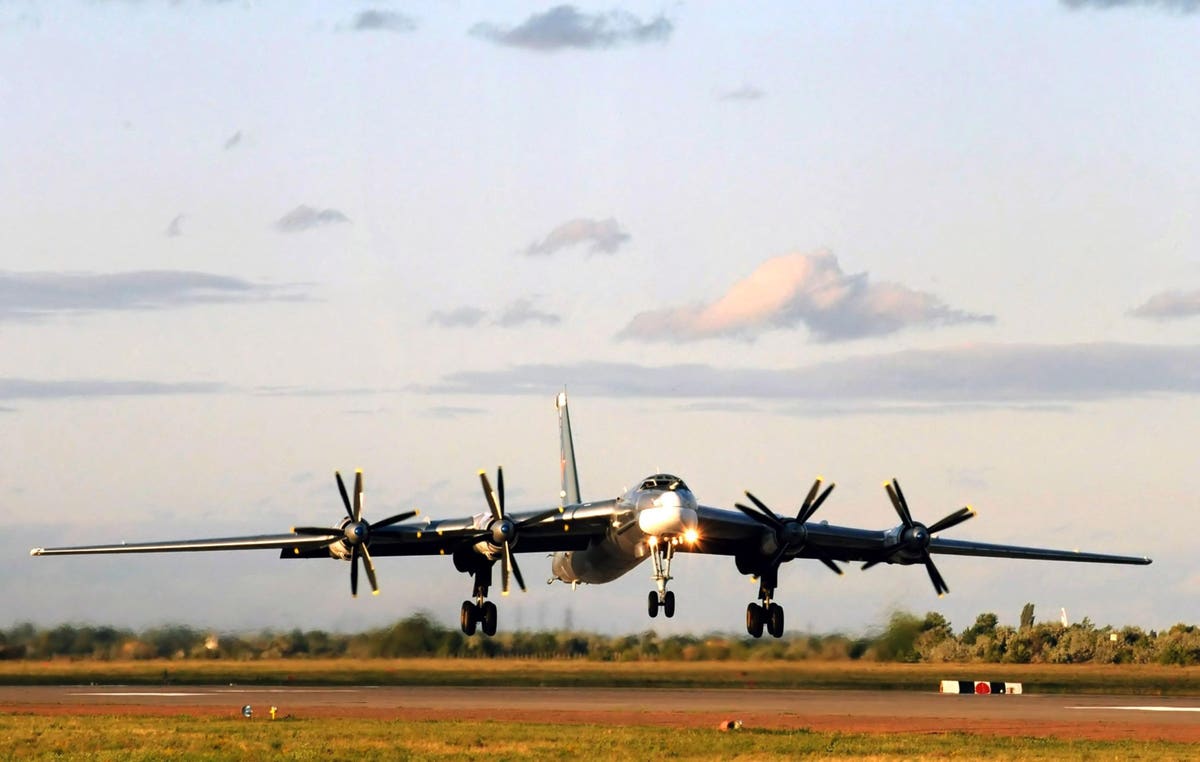
Images of the Russian Engels Airbase (Engels-2) circulated on social media over the weekend that seemed to show painted silhouettes of the Tupolev Tu-95 on the tarmac. It was apparently the latest tactic by the Kremlin to help protect its propeller-driven, long-range strategic bombers, which have come under an increasing number of Ukrainian drone and missile strikes.
Images of the painted bombers first appeared online last Friday, and the two-dimensional decoys initially succeeded in capturing many of the four-engine bomber’s distinctive features, yet the deception failed for one notable point noticed and shared by users on the social platforms—2D painted airplanes don’t cast shadows!
Deception Effort
Though it is true that the silhouettes aren’t 100% perfect, such forms of trickery have existed for as long as there have been ways to be spotted from above. Some efforts were little more than netting, while during the Second World War, a faux three-dimensional city was literally built over the Boeing Plant 2 (Air Force Plant 17) in King County, Washington.
These efforts by Moscow are much the same, the goal is to help confuse an enemy.
“Ukrainian forces have successfully struck air bases in Russian territory on several occasions in recent months, notably including an attack in September that reportedly destroyed four Il-76 military transport planes in Pskov Airport,” said Mark Episkopos, managing editor of Warrior Maven. “These attacks have clearly caught Moscow flatfooted, leaving the Russians scrambling to find effective countermeasures.”
Trial And Error
This latest effort also seems to be a step up from last month, when the Russian military simply placed rubber tires over its aircraft to conceal them from drone attacks. As previously reported, that effort was also met with a great deal of mockery.
“Many of the current efforts to counteract Ukrainian attacks are half-baked and will inevitably fail, but Russia has the time and resources to learn from its failures,” added Episkopos. “The next such silhouette could quite possibly come with a shadow, or the Russians may even try to simulate air traffic activity to fool the Armed Forces of Ukraine into striking nonexistent targets. As Russia discovers tools to counteract Ukrainian tactics through trial and error, the challenge for the AFU going into winter is to keep finding new vulnerabilities to exploit.”
It is also important to note that the Russians shouldn’t be seen as bad at disinformation campaigns, even if these latest efforts are coming under so much scrutiny.
“Honestly they wrote the original book on the subject in 1923, and are very good in this area. In cases like this, you see a couple of things happening,” explained Dr. Cliff Lampe, professor of information and associate dean for academic affairs in the School of Information at the University of Michigan. “First, sometimes the goal of these attempts, isn’t actually to trick anyone, there’s some other goal we may not know.”
In this case, it is likely about confusing a drone so that it slams into the concrete rather than a Tu-95 bomber. Concrete can be easily replaced, the bomber cannot.
The Social Media Variable
Russia’s efforts—whether in 1923 or 2023—may not be factoring in the ability of social media to easily uncover and then reveal to the world these efforts. It is a variable to the constant that is Russian deception campaigns.
“Social media environment and related technologies really do make it hard to hide things to people who are committed to digging for information,” suggested Lampe, who further noted the old saying in software development attributed to Erik S. Raymond, “Given enough eyeballs, all bugs are shallow.”
It essentially takes the view that that with enough individuals seeking to find problems, almost every problem will be characterized quickly and the fix will be obvious to someone.
“In this case,” said Lampe, “With enough attention and information, it’s hard for anyone to hide something like this.”
But no doubt, the Kremlin will try again, and social media will be there.
“It’s hard to say if it’s social media or intel from the U.S. or commercial satellites that unmask these things,” said Dr. Matthew J. Schmidt, associate professor of national security and political science at the University of New Haven. “But certainly social is now a potent force on the battlefield.”
Read the full article here



