


Vanderbilt researchers are part of a team that has developed a cutting-edge method that seeks to make the removal of salt from hypersaline industrial wastewater far more energy-efficient and cost-effective.
While desalination through reverse osmosis has made tremendous strides—allowing for salt removal from seawater for less than a penny per gallon—it still falls short in eliminating saline in wastewater from industries like mining, oil and gas and power generation and in inland brackish water. The industrial brines are currently injected into deep geological formations or transferred to a evaporation ponds, and both disposal methods are facing more regulatory and environmental challenges.
Zero liquid discharge and minimal liquid discharge, which use engineered treatment systems to eliminate brines or minimize brine volume, are already required in some countries for certain industries, and they are expected to become more widely adopted soon. Current ZLD/MLD treatments typically involve a technology called mechanical vapor compression, which generates heat from electricity to evaporate brines until the salt is all that remains. Because of the high capital and operating costs of MVC, these processes are unaffordable to many users.
Associate professor of civil and environmental engineering and 2023 Chancellor Faculty Fellow Shihong Lin and his team, including researchers from Colorado State University, believe they have an answer to this dilemma.
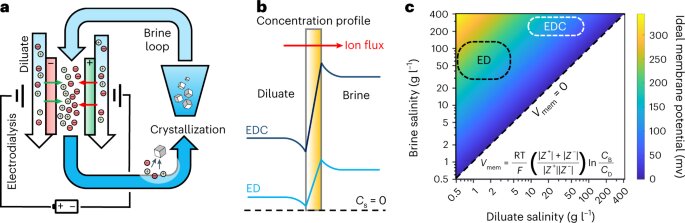
In a paper featured on the cover of Nature Water, Lin and his colleagues describe a novel brine treatment technology called electrodialytic crystallization that has the potential to reduce the energy consumption and cost of brine crystallization. The fundamental principle of EDC, according to the researchers, is like electrodialysis, a process that has been used in various industries for desalination and brine concentration.
In ED, an electric field is applied to pull ions through ion exchange membranes. By placing different types of IEMs in a certain way, ED can produce streams of deionized water and streams of concentrated brine. With some configuration changes to that process, the researchers say EDC keeps the brine within the integrated system and uses an electric field to induce salt crystallization without using costly evaporation methods.
“The elimination of evaporation is the key to developing potentially energy efficient brine crystallization processes,” according to the paper.
One major technical challenge is that when certain ions transport through the IEMs, they drag too much water across and reduce the effectiveness of the process in concentrating the brine stream. This phenomenon, called electro-osmosis, prevents some salts from being crystallized out effectively. The researchers said that better membrane design and optimized operation can potentially address this challenge and make EDC more universally applicable.
Nevertheless, for the salts that EDC can handle, the team performed a preliminary analysis and showed that EDC coupled with reverse osmosis can potentially consume much less energy than MVC for brine crystallization.
More information:
Xudong Zhang et al, Electrodialytic crystallization to enable zero liquid discharge, Nature Water (2023). DOI: 10.1038/s44221-023-00095-4
Vanderbilt University
Read the full article here


