



People across Kenya were mysteriously plunged into darkness last month as the country suffered its worst power outage in a generation—except for a tiny remote village.
Now experts from the University of Southampton have revealed how their mini grid power plant, fueled solely by the sun’s energy, kept the lights on across the community of Kitonyoni, in Kenya’s eastern province.
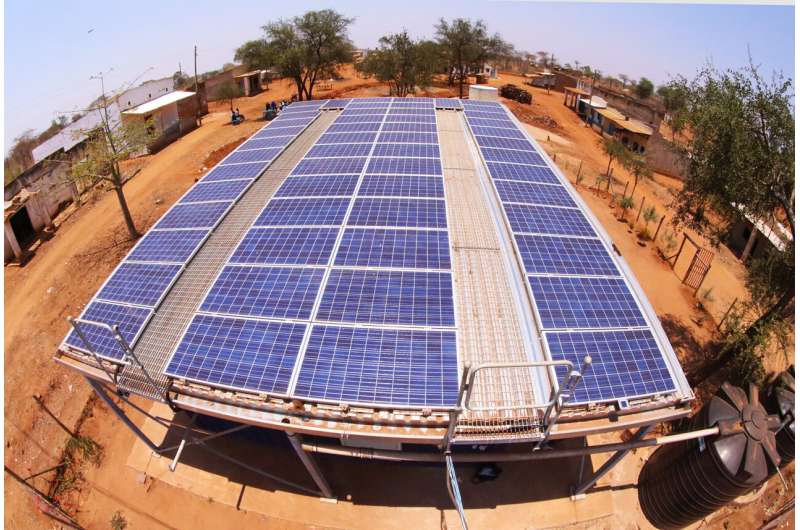
The solar-photovoltaic plant, the first of its kind to be installed in Africa back in 2012, is just a few meters square in size but creates enough energy to power the village alongside its school and hospital.
It kept Kitonyoni, located in Makueni county, powered during Kenya’s massive outage—which affected most of its population of 50 million, including those in the capital of Nairobi, for almost 24 hours.
Engineers behind its creation, called the Energy for Development (e4D) project, which includes the University of Southampton, Ministry of Energy Kenya and Kenya Power and Lighting Company, hope to roll it out across Africa, where 600 million people have no access to electricity.
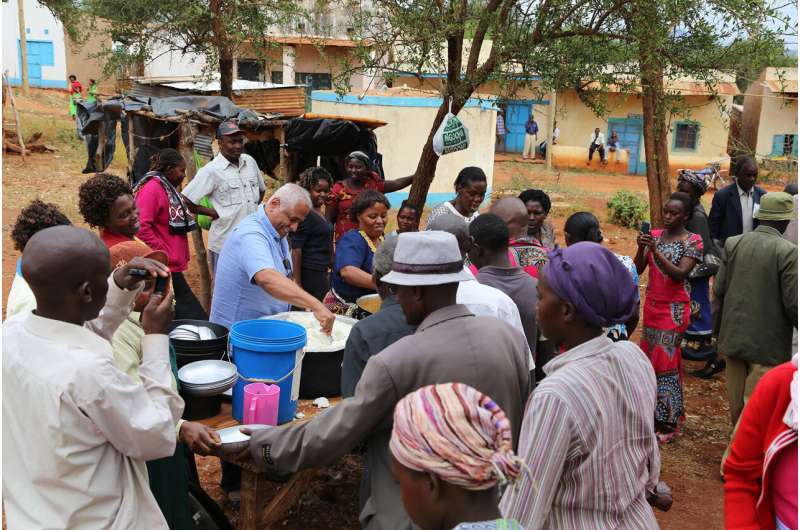
Professor AbuBakr Bahaj, from the Energy and Climate Change Division at Southampton, said, “The Kitonyoni villagers were the envy of all Kenya, and people from the surrounding villages rushed into its trading center during the blackout to charge their mobile phones and appliances.
“Kitonyoni has grown tremendously, by a factor of three, since we installed the e4D plant due to the availability of electricity, a growth not seen in our control village 30km away. I remember that the tailor William, who worked with us from the start, wished for an electric iron to replace his wood heated iron—that was duly delivered the second time I visited.”
The Kitonyoni mini grid consists of solar panels and battery storage connected to a distribution network. It took Prof Bahaj and his scientific team just a week to build the first design—which had a capacity of 13.5kWp of uninterrupted power, giving the villagers around-the-clock power for the first time.
The solar canopy also acts as a rain collector, and during the wet season, stores enough water for a year—a vital feature for Kitonyoni, which is not connected to a main supply. According to Prof Bahaj, villagers can also generate income by selling the electricity to nearby towns and cities.
The cause of blackout in Kenya, the longest blackout in memory, remains unclear. But such is the success of the Kitonyoni plant that the Kenyan government has since applied for $150 million worth of funding from the World Bank to build more than 100 mini grids across the country, said its Secretary for Renewable Energy Eng Isaac Kiva.
He added, “The reliability shown by the system in Kitonyoni during the blackout was a testament to the UK and Kenyan engineers to deliver solutions that can be widely replicated and deployed to provide electrical power to over 600 million people without energy in Africa.”
The Kitonyoni e4D mini grid is one of six electricity projects across Kenya as well as Uganda and Cameroon.
University of Southampton
Read the full article here


