


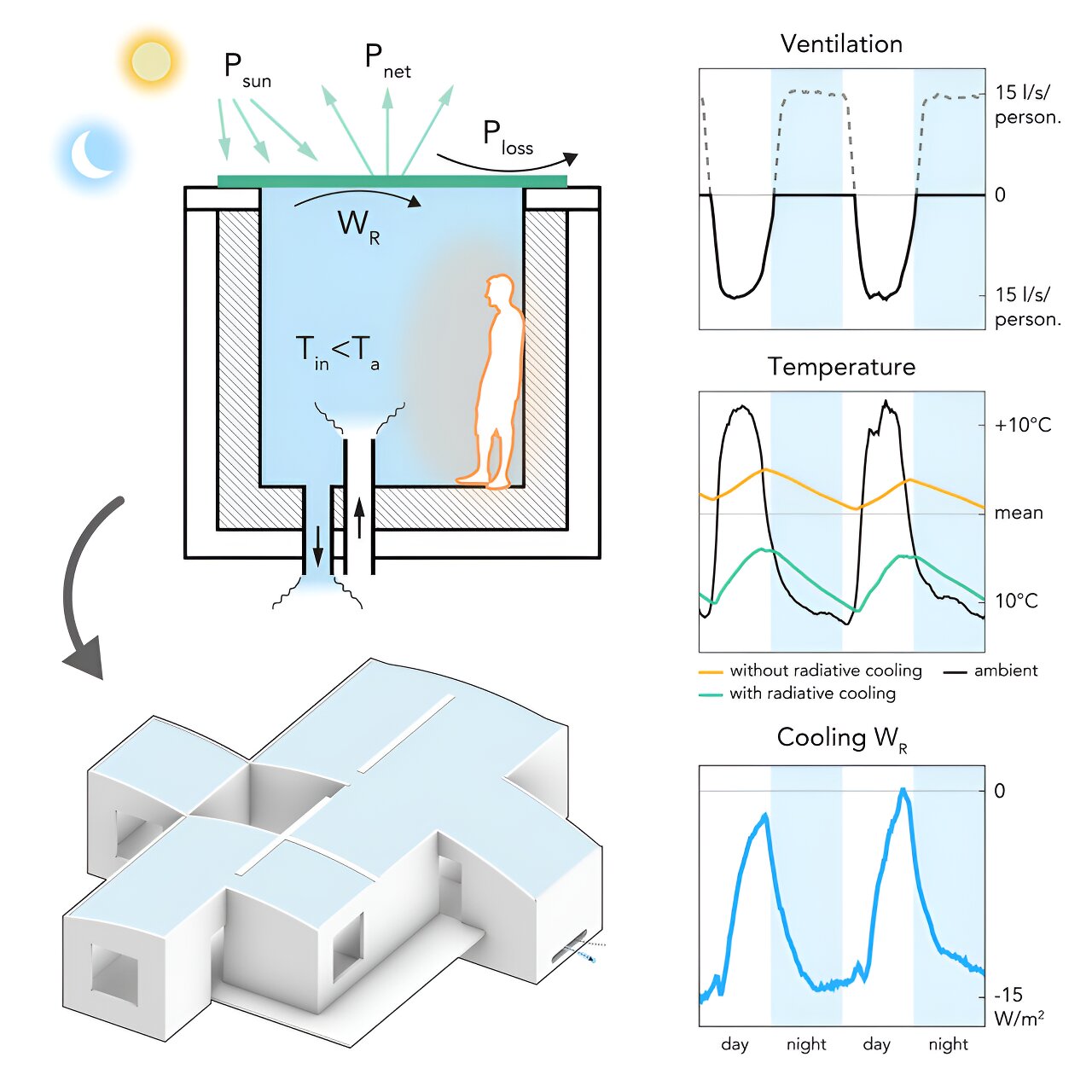
As the planet gets hotter, the need for cool living environments is becoming more urgent. But air conditioning is a major contributor to global warming since units use potent greenhouse gases and lots of energy.
Now, researchers from McGill University, UCLA and Princeton describe in a new study an inexpensive, sustainable alternative to mechanical cooling with refrigerants in hot and arid climates, and a way to mitigate dangerous heat waves during electricity blackouts.
The study, titled “Passive radiative cooling to sub-ambient temperatures inside naturally ventilated buildings,” is published in Cell Reports Physical Science.
The researchers set out to answer how to achieve a new benchmark in passive cooling inside naturally conditioned buildings in hot climates such as Southern California. They examined the use of roof materials that radiate heat into the cold universe, even under direct sunlight, and how to combine them with temperature-driven ventilation.
These cool radiator materials and coatings are often used to stop roofs overheating. Researchers have also used them to improve heat rejection from chillers. But there is untapped potential for integrating them into architectural design more fully, so they can not only reject indoor heat to outer space in a passive way, but also drive regular and healthy air changes.
“We found we could maintain air temperatures several degrees below the prevailing ambient temperature, and several degrees more below a reference ‘gold standard’ for passive cooling,” said Remy Fortin, lead author and Ph.D. candidate at the Peter Guo-hua Fu School of Architecture “We did this without sacrificing healthy ventilation air changes.” This was a considerable challenge, considering air exchanges are a source of heating when the aim is to keep a room cooler than the exterior.
The researchers hope the findings will be used to positively impact communities suffering from dangerous climate heating and heat waves.
“We hope that materials scientists, architects, and engineers will be interested in these results, and that our work will inspire more holistic thinking for how to integrate breakthroughs in radiative cooling materials with simple but effective architectural solutions,” said Salmaan Craig, Principal Investigator for the project and Assistant Professor at the Peter Guo-hua Fu School of Architecture.
More information:
Remy Fortin et al, Passive radiative cooling to sub-ambient temperatures inside naturally ventilated buildings, Cell Reports Physical Science (2023). DOI: 10.1016/j.xcrp.2023.101570
McGill University
Read the full article here


