


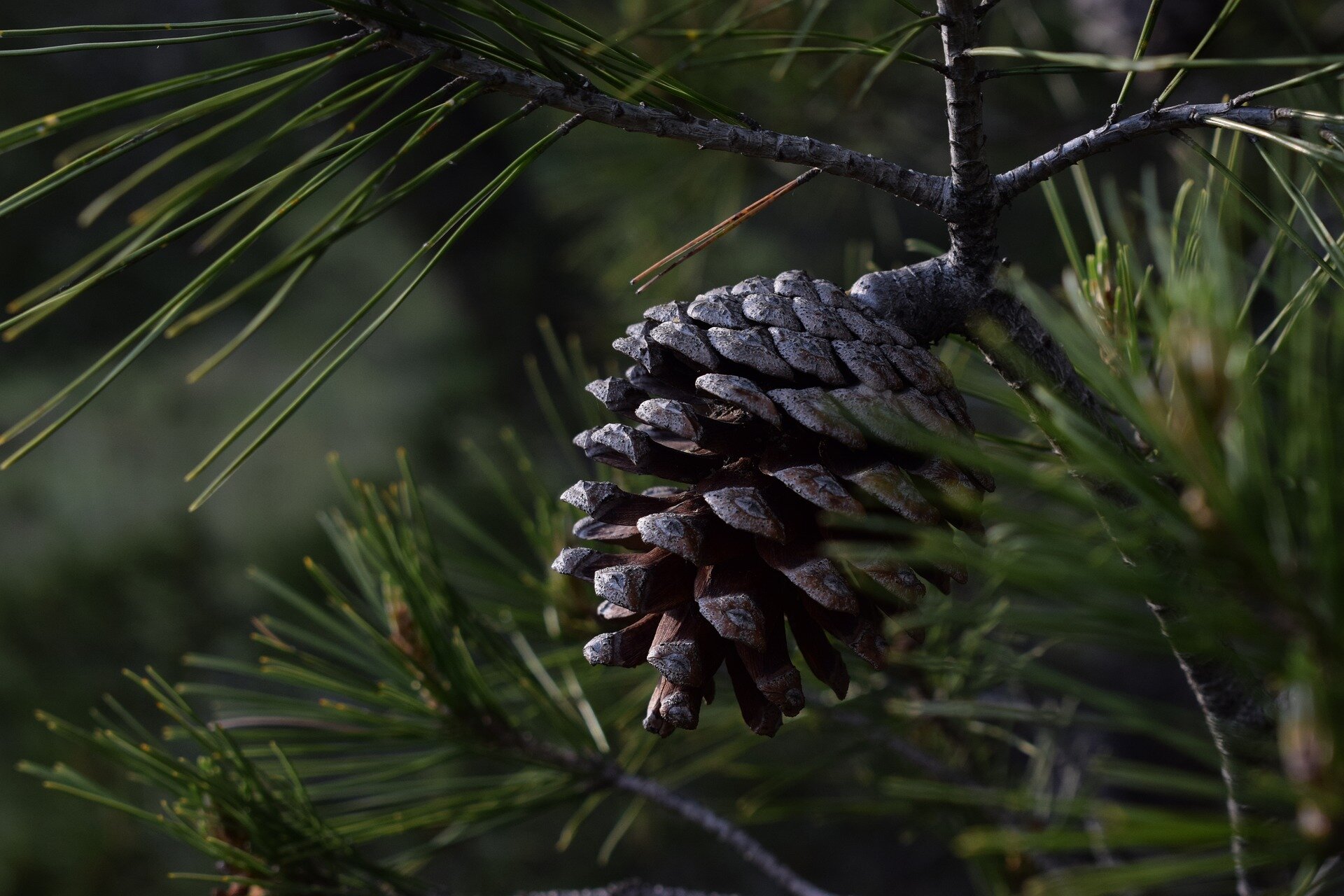
Researchers have found how to convert cost free forest waste, like pine cones, into carbon materials useful for energy storage. The method allows for easy and environmentally friendly dispersion of carbon in water, even when it is not water-soluble. The blend can then be sprayed onto a surface to produce electrodes for supercapacitors.
Supercapacitors are energy storage devices, similar to batteries, but storing energy in a different way. Supercapacitors can be charged and discharged much faster compared to batteries, cycled nearly unlimited number of times and operated over significantly longer lifespan compared to batteries. Supercapacitors are already used in some industries and are predicted to play an increasingly important role in the future as the need for energy storage is expected to grow.
High surface area electrodes, i.e., electrodes with a large surface area in relation to their volume, are the key element of supercapacitors. Andreas Nordenström, doctoral student at the Department of Physics at Umeå University, shows that high quality electrodes can be produced by spraying, or painting, water-based dispersions based on high surface area carbon materials. Different types of carbon materials can be used in the water-based dispersions designed by the researchers, including porous carbons produced from various forest waste.
“The water-based dispersion has several advantages over dispersions based on organic solvents, which are often toxic and bad for the environment. The solvents are particularly problematic in this context because the dispersions are sprayed on hot surfaces producing toxic vapor,” says Andreas Nordenström.
The procedure developed by researchers to produce porous carbons was earlier developed for “activated graphene,” a material prepared starting from reduced graphene oxide. However, the same chemical treatment applied to carbonized pine cones, spruce cones and pine bark was found to produce very similar carbon materials with extremely high surface area. These porous carbons are also nearly equally good for preparation of electrodes and energy storage applications.
“We demonstrated that rather expensive ‘activated graphene’ is just another kind of activated carbon and can be replaced by cheap, high-quality electrodes prepared from forest waste. The interest to recycle forest waste will likely increase in the future as the demand for energy storage devices such as supercapacitors is expected to increase,” says Nordenström.
The water-based dispersions can also play an important role for future research projects as the method can be used for different types of non-water soluble carbon materials.
“Porous carbons are very difficult to prepare in stable water-dispersions. Simply mixing carbon with water does not work as the carbon particles drop to the bottom in few minutes time. Using graphene oxide and fumed silica as added components, we solved the problem. We heard from industrial colleagues that dispersion prepared using our method was stable on their shelf for over one year.”
In his thesis, Nordenström has also studied graphite oxide, a carbon material that can be modified in many ways and for many potential applications. The research results increase the basic understanding of the material and show, among other things, how graphite oxide can be used in membranes which might be of interest for various filtration applications.
On Friday, September 29, Nordenström, Department of Physics, will defend his thesis entitled “Properties and applications of materials based on graphene oxide.”
Umea University
Read the full article here


