


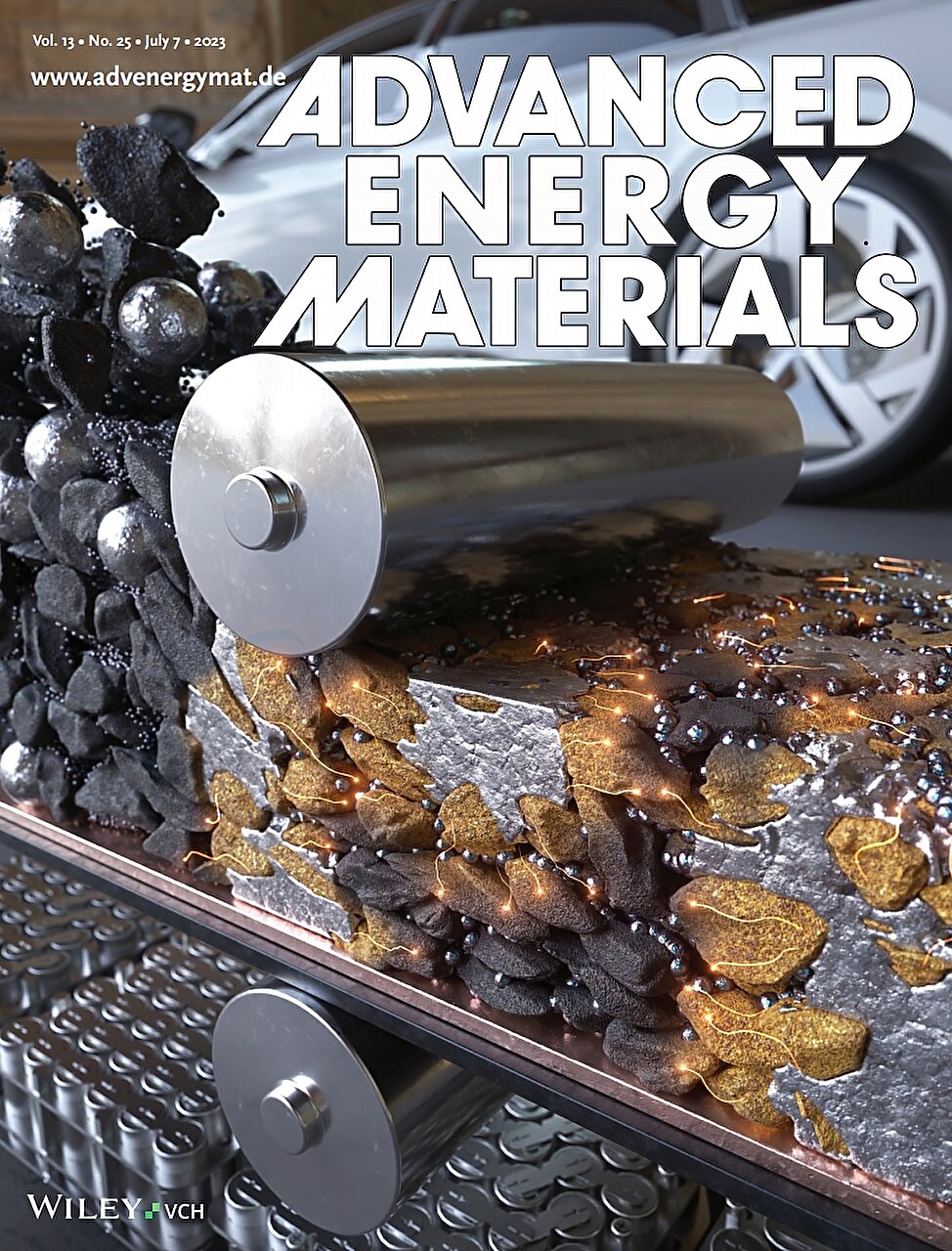
A joint research team including Professor Yongmin Lee from the Department of Energy Science & Engineering at DGIST and ETRI has developed high-energy-density, high-stability all-solid-state battery electrodes by applying the prelithiation technology to graphite-silicon-diffusion-based electrodes.
An all-solid-state battery, a next-generation secondary battery where the electrolyte carrying ions is solid, demonstrates excellent stability and high fire resistance. All-solid-state batteries are emerging as the next-generation secondary battery with high energy density due to the use of high-capacity active materials.
Existing all-solid-state battery electrodes have a complicated composition, and thus are limited in terms of energy density. Thus, the DGIST-ETRI joint research team developed a new type of electrode where ions are delivered by diffusing them between active materials rather than through electrolyte. Electrodes with such a structure are mostly composed of active materials, thus exhibiting advantages with respect to energy density per volume and mass.
However, silicon has low initial charging-discharging efficiency, which causes loss and reduced capacity of the lithium. To address this problem, the DGIST-ETRI joint research team applied the prelithiation technology to graphite-silicon-diffusion-based electrodes. This technology involves inserting lithium into active materials in advance to supplement the capacity loss during initial charging. Accordingly, the electrode life can be improved as the volume expansion is lessened and the initial capacity reduction of silicon is mitigated.
Despite this advantage, it has been challenging to apply the prelithiation technology to all-solid-state battery electrodes because it was developed for lithium-ion batteries based on liquid electrolyte. The DGIST-ETRI joint research team, however, overcame this drawback by developing a simple yet effective prelithiation technology.
The newly developed technology supplies lithium by uniformly dispersing micro lithium particles into diffusion-based electrodes. Micro lithium particles come into contact with graphite and silicon when making all-solid-state batteries, which spontaneously charges the lithium. The advantage of this technology is that the process is simple.
The graphite-silicon-diffusion-based electrodes to which the new prelithiation technology was applied demonstrated higher initial charging-discharging efficiency and improved electrochemical properties compared to conventional electrodes. In addition, volume expansion, which occurs during electrode lithiation, was reduced by nearly 40%, thus improving electrode life.
Professor Yongmin Lee said, “We have developed and applied a simple yet effective prelithiation technology to graphite-silicon-diffusion-based electrodes for all-solid-state batteries, which resulted in high energy density and high stability in all-solid-state battery electrodes,” and added “the newly developed prelithiation technology will heighten the feasibility of commercializing high-energy-density all-solid-state batteries by implementing high-capacity silicon-based electrodes with a longer life expectancy.”
Dr. Juyoung Kim of the ETRI Smart Materials Lab said, “We suggested the design of all-solid-state electrodes utilizing ion diffusion among active materials, while excluding solid electrolyte, for the first time in the world in 2020 and have been continuously researching to improve the performance.” Dr. Kim added, “continuous cooperation between DGIST and ETRI will help us find more outstanding design technologies of all-solid-state electrodes.”
The paper is published in the journal Advanced Energy Materials.
More information:
Jongjun Lee et al, Dry Pre‐Lithiation for Graphite‐Silicon Diffusion‐Dependent Electrode for All‐Solid‐State Battery, Advanced Energy Materials (2023). DOI: 10.1002/aenm.202300172
Provided by
DGIST (Daegu Gyeongbuk Institute of Science and Technology)
Read the full article here


