


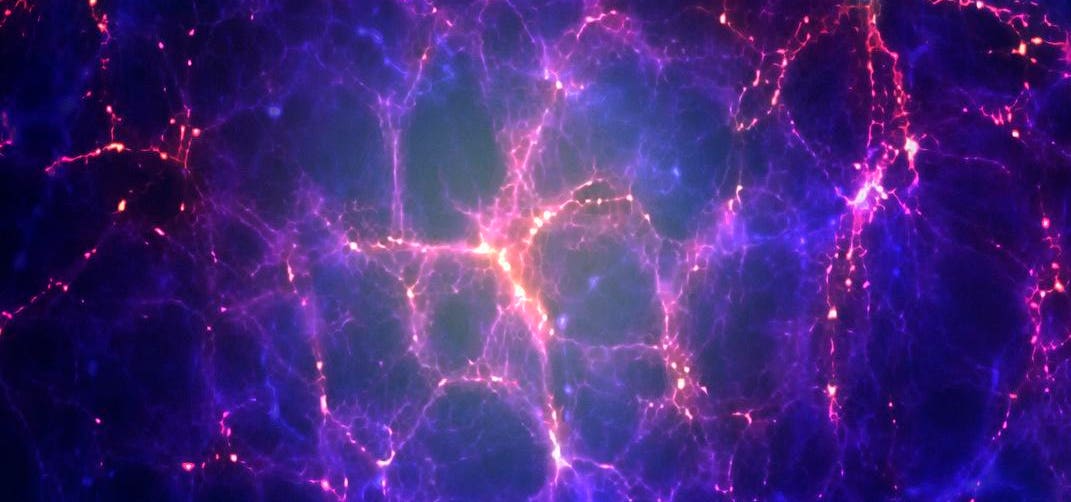
The same team of scientists that discovered that our Milky Way is one of 100,000 galaxies inside a supercluster has found a larger structure deeper into the universe.
The vast bubble 820 million light-years from Earth was unexpectedly found within a web of galaxies being mapped by a team led by Brent Tully the University of Hawaii.
It’s been named Hoʻoleilana, a Hawaiian creation chant evoking the origin of structure. It joins—but is much larger than—the Laniākea supercluster, which means “immense heaven.” Tully’s team discovered Laniākea in 2014.
The discovery of Hoʻoleilana, details of which are published in The Astrophysical Journal, was by chance. “We were not looking for it,” said Tully. “It is so huge that it spills to the edges of the sector of the sky that we were analyzing.”
It was already well known that galaxies form in groups of dozens or more, and that groups are found in clusters that in turn create a web-like structure.
But Hoʻoleilana is on a different scale. Inside the structure—found by chance by astronomers mapping the distances to 56,000 galaxies—are previously known superclusters of galaxies. They include the Coma Cluster, the Hercules Cluster, the Sloan Great Wall, the Boötes Supercluster and the empty Boötes Void. “It was an amazing process to construct this map and see how the giant shell structure of Hoʻoleilana is composed of elements that were identified in the past as being themselves some of the largest structures of the universe,” said the team’s cartographer, researcher Daniel Pomarede of CEA Paris-Saclay University, France.
Structures like Hoʻoleilana are thought to be the result of ripples found in the early universe—something called Baryon Acoustic Oscillations—but Hoʻoleilana is a much stronger feature than expected, said the scientists. “The very large diameter of one billion light years is beyond theoretical expectations,” said Tully.
By comparison, Laniākea—which neighbors Hoʻoleilana—is about 500 million light years in diameter.
which is thought to XXXXX,
a giant cosmic “bubble”
that spans 1 billion light-years.
the Laniakea Supercluster
Read the full article here



