


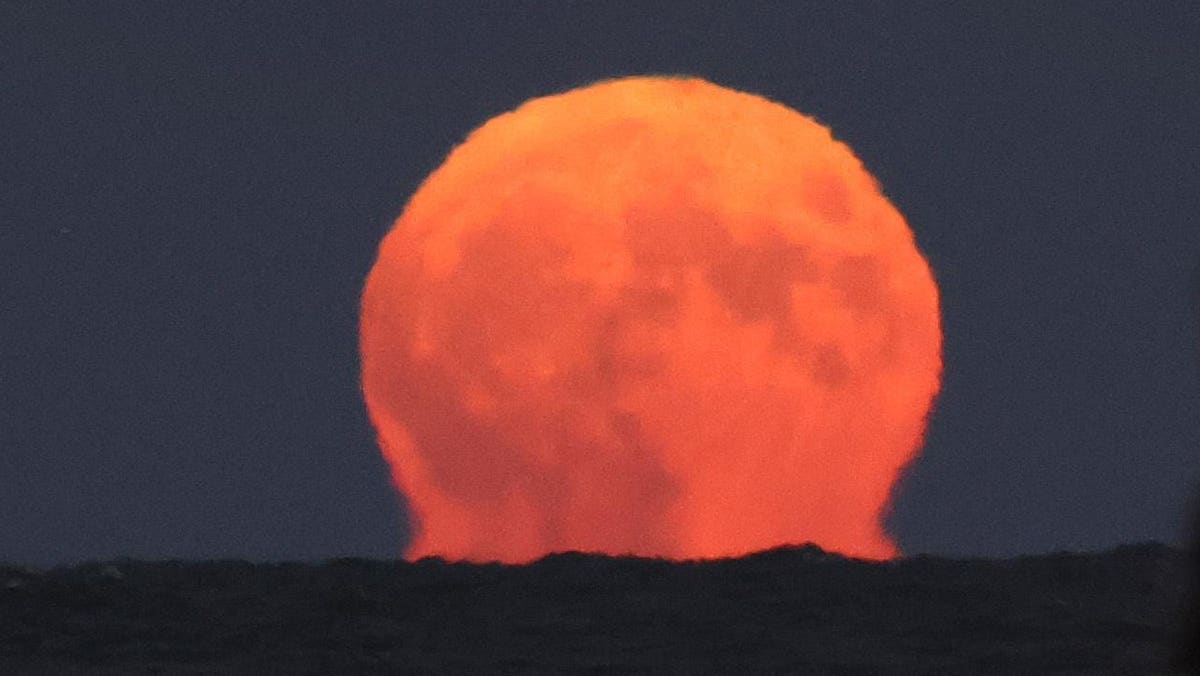
Did you see the “Blue Supermoon” this week? Best seen rising on Wednesday evening and setting on Thursday morning, the celestial sight was photographed around the world just as India’s Chandrayaan-3 mission was exploring its surface.
It was the third so-called supermoon of 2023, but the largest of the year. A supermoon is said to occur when a full moon happens while the moon is at or close to it nearest point to Earth. That’s possible because the moon’s orbital path around Earth is slightly elliptical.
In every orbit of Earth the moon comes to a perigee (closest) and apogee (most distant), which occur every month 14 days apart. When perigee happens on or close to a full moon it’s popularly termed a supermoon. This month the full moon occured just 10 hours after its perigee.
At 222,023 miles (357,311 km) from Earth it was the closest full moon 2023, so the biggest (by 10-15%) and brightest (25-30% brighter) full moon of the year. However, it won’t be the last. Next month’s full moon, the “Harvest Moon,” is also technically a supermoon.
It was also the second full moon in August, following the “Sturgeon Supermoon” in early August. That qualified it for the status of a “Blue Moon.” Having two supermoons in the same month is relatively rare, although it last happened in 2018. The next time there will be two supermoons in the same month is 2037.
Onlookers saw not only the full moon, but also a bright light close to its disk. Saturn, the “ringed planet,” is just past its bright opposition, a point in Earth’s orbit when it’s between the sun and the planet. Saturn is therefore as close, as bright and as fully lit as it ever gets during Earth’s year.
While moon-gazers were enjoying the sight of the “Super Blue Moon” there was a rover exploring its south polar regions. On Aug. 23, India became only the fourth nation to successfully soft-land a spacecraft on the surface of the moon when its uncrewed Chandrayaan-3 mission became the first to land close to the moon’s south pole.
The next full moon, the “Super Harvest Moon” or “Harvest Supermoon,” will be 100% illuminated at 4:59 a.m. EDT on Friday, September 29, 2023 and best seen from North America at moonrise later that day.
Wishing you clear skies and wide eyes.
Read the full article here



