


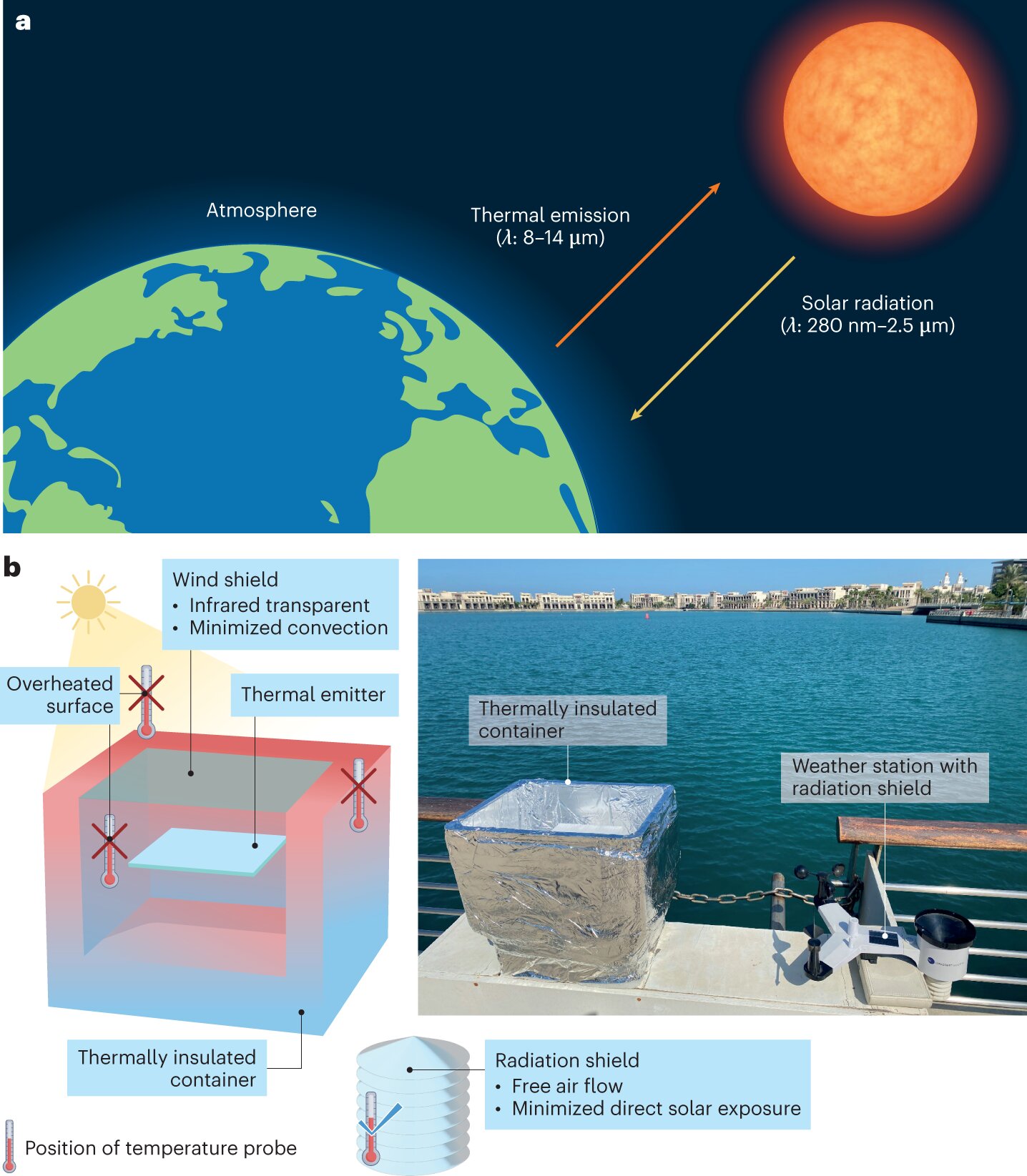
In a world experiencing increased heat stress, a zero-carbon-emission cooling technology that consumes no electricity, operating instead by shedding heat directly into outer space, would be a groundbreaking advance. However, poor standardization and a lack of transparency is hampering this promising technology, known as radiative cooling. Best practice guidelines, outlined by KAUST leading radiative-cooling researcher Qiaoqiang Gan, could help set the research field back on track.
Radiative-cooling devices offer electricity-free cooling by radiating heat within a narrow wavelength range called the atmospheric transparent window. Within this window the heat is not reabsorbed by the atmosphere and instead escapes into space, which, at three degrees above absolute zero, acts as a vast heat sink and readily soaks up the emitted heat. “The technology is particularly attractive to address local cooling needs in Saudi Arabia,” Gan says.
Many materials display radiative cooling at night. “The key challenge is to achieve cooling to below ambient temperatures while under direct sunlight,” Gan says. “One must simultaneously minimize the heating effect of solar absorption while maximizing thermal emission in the atmospheric window.” Despite the challenge, there is rapidly growing interest in this sustainable cooling technology due to its potential to counter the impact of global warming.
However, there are numerous potential pitfalls when testing and reporting new radiative cooling materials, Gan notes. As radiative cooling uses the sky as a heat sink, most experiments are conducted in the local outdoor environment. “Due to uncontrollable weather conditions and variations in measurement settings, it becomes challenging to compare and comprehend the actual cooling performance of different technologies, and so to identify the best strategies among the various radiative cooling designs being studied,” Gan says.
“After discussing these issues with a senior editor at Nature Sustainability, we were invited to write an article proposing standardized criteria and characterization procedures for evaluating radiative cooling performance,” Gan adds. His team developed clear recommendations for radiative-cooling material characterization—and procedures for calculating cooling—to improve the reliability and comparability of radiative-cooling research.
“We hope this framework will contribute to the advancement of sustainable and efficient cooling solutions,” Gan says. Considering the extreme heat wave experienced in 2022 and the record-breaking high temperatures observed in numerous major cities during the first half of 2023, the need for electricity-free cooling solutions has become more critical than ever, he adds. “By leveraging radiative cooling, which has the potential for zero or even negative carbon emissions, we can effectively address this global challenge and support the Saudi national strategic plan of Vision 2030.”
More information:
Lyu Zhou et al, Best practices for radiative cooling, Nature Sustainability (2023). DOI: 10.1038/s41893-023-01170-0
King Abdullah University of Science and Technology
Read the full article here


