


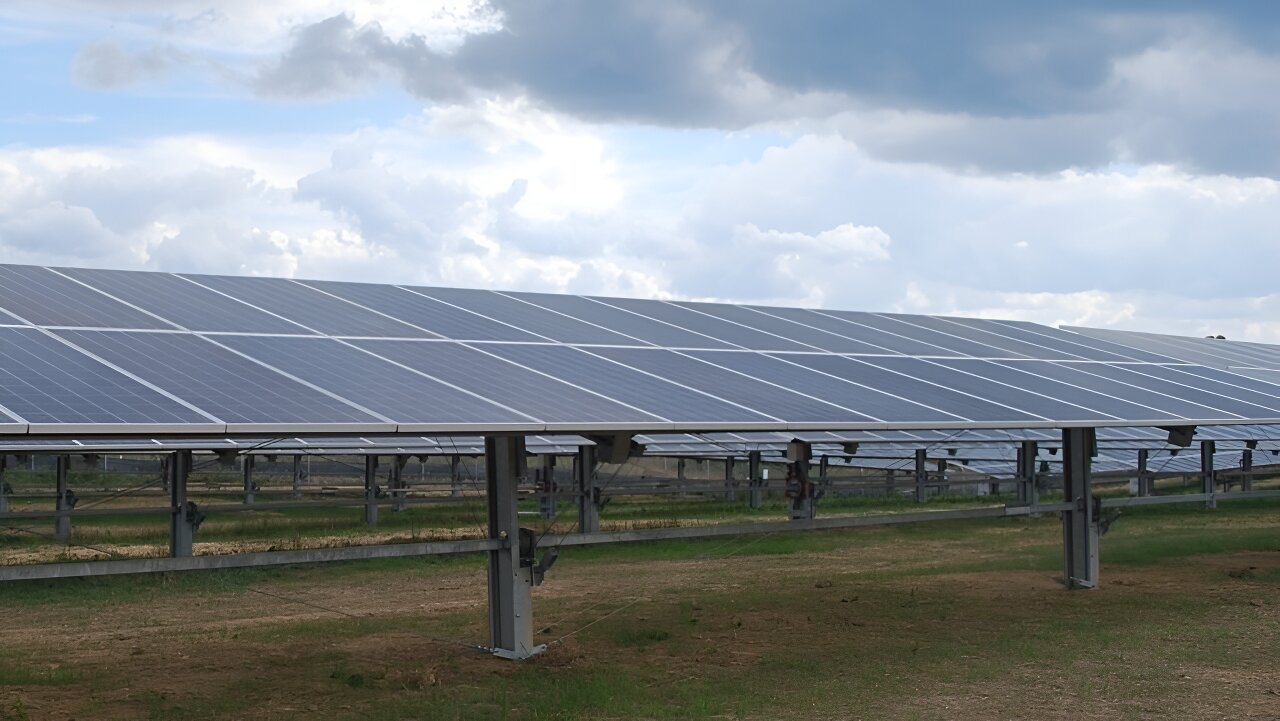
While the nation sharpens its focus on decarbonizing the electric grid, researchers at the University of Tennessee Institute of Agriculture have completed a timely study to determine Tennessee’s current and projected land use for utility-scale solar energy production and possible impacts on the state’s farmland.
The nation’s use of solar energy has increased drastically over the last decade, growing from 0.6% to 4.8% of total U.S. electricity produced. Further, the U.S. Department of Energy projects solar generation could provide as much as 40% of the nation’s electricity supply by 2035. Rapid expansion and projections of continued growth were drivers in this latest research to determine the amount of land needed to accommodate the increase in solar installations in Tennessee.
The study determined that Tennessee’s current operational and contracted utility-scale facilities would generate 1,474 megawatts of energy and require between 8,197 to 14,743 acres of land, equating up to 0.056% of the state’s total land mass or up to 0.137% of the state’s agricultural lands. Most of these utility-scale solar facilities are in the western portion of the state.
To meet customer demand and system needs, the Tennessee Valley Authority recently announced their goal of adding 10 gigawatts of solar power by 2035. An additional 10 GWs of solar energy generation would require another 55,600 to 100,000 acres of land. If Tennessee is the sole location of this solar energy production, as opposed to being spread across all seven TVA states, the resulting additional land use would represent from 0.21% to 0.38% of the state’s total land mass or 0.52% to 0.93% of Tennessee’s farmland. These numbers are contingent on the extent of TVA’s progress toward the goal, the share of solar production located in Tennessee, and potential technological advances that could reduce the amount of land needed to generate the energy.
Researchers also examined the extent that Tennessee farmland has been lost to urban and residential uses. From 1997 to 2017, Tennessee’s land in farms decreased from 11.99 million acres to 10.87 million acres, a reduction of 1.11 million acres or about 9% of Tennessee’s farmland. The state’s farmland loss is primarily due to its increasing population, and these losses are projected to continue. The American Farmland Trust projects Tennessee will convert another 420,000 farmland acres to urban and residential uses between 2016 and 2040. The Trust ranks Tennessee third among all U.S. states in terms of acres of nationally significant agricultural land projected to be converted to urban and highly developed residential uses by 2040.
The study also discusses solar development considerations for agricultural communities and addresses the potential use of agrivoltaics, the use of solar panels alongside agricultural production. In some instances, agrivoltaics may provide mutual benefits and ease concerns over the removal of productive land from agriculture.
Comprising the research team are Karen DeLong, Olivia Murphy, David Hughes and Chris Clark from UT’s Department of Agricultural and Resource Economics and Harry Crissy from Pennsylvania State University.
More information:
Karen L. DeLong et al, Evaluating Potential Land Use of Utility-Scale Photovoltaics (Solar Panels) on Farmland in Tennessee (2023). DOI: 10.22004/ag.econ.337419
Provided by
University of Tennessee Institute of Agriculture
Read the full article here


