


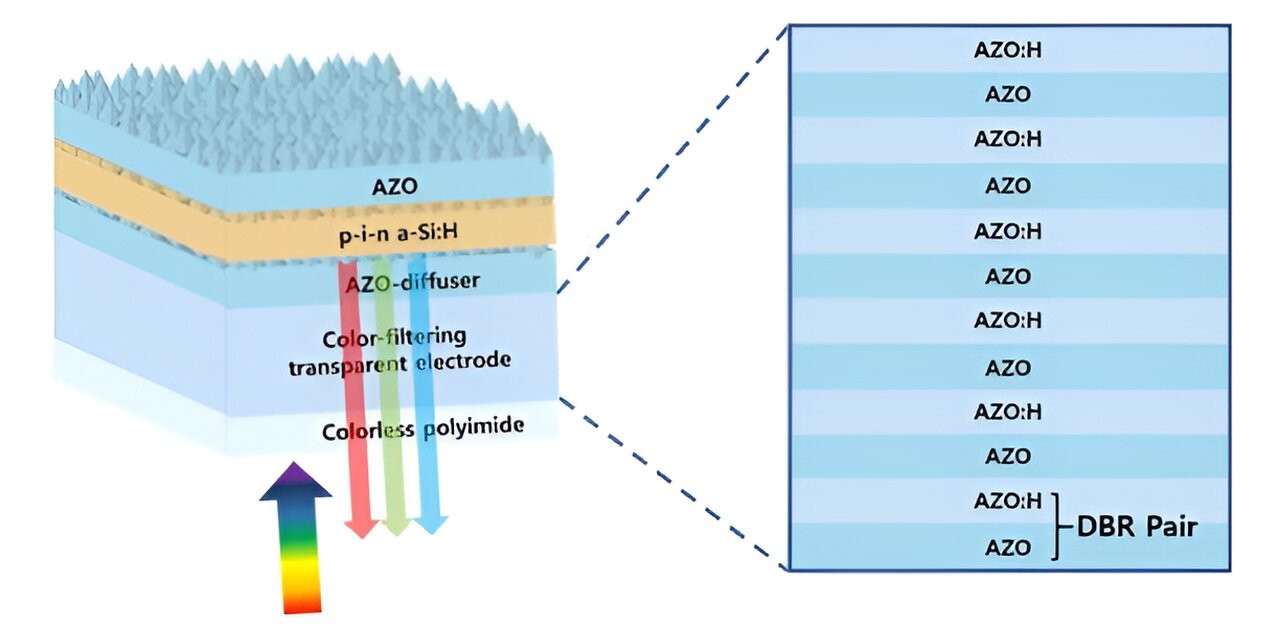
A research team led by Dr. Jung-dae Kwon from the Department of Energy & Electronic Materials at the Korea Institute of Materials Science has succeeded in realizing the world’s first transparent thin-film solar cell on a flexible substrate that exhibits different reflective colors and does not significantly reduce the solar cell’s efficiency. The research results were published in the Chemical Engineering Journal.
This is a technology that achieves reflective color in a single material by periodically incorporating hydrogen into zinc oxide doped with aluminum, which is a transparent electrode, to induce a refractive index difference.
By designing a multi-layer thin film with an extremely low refractive index difference of less than 5%, the reflection loss in the visible light region absorbed by the solar cell device was minimized. It can be applied to various absorbers for thin-film solar cells as it hardly reduces the solar cell efficiency due to color implementation. In addition, it is expected to serve as a benchmark for improving the aesthetics of flexible substrate transparent thin-film solar cells for BIPV (building integrated photo voltaic) and VIPV (vehicle integrated photo voltaic).
To date, multi-layer thinning technology for materials with large refractive index differences, color control thin film coating technology for designing optical properties, and natural structure mimicking structural color technology have been used as color application methods to improve the aesthetics of transparent thin film solar cells. However, these technologies are not suitable for solar cells that absorb visible light due to a wide reflection band and high reflectivity, or they require complex technologies that are difficult to apply industrially in terms of two or more materials and processes.
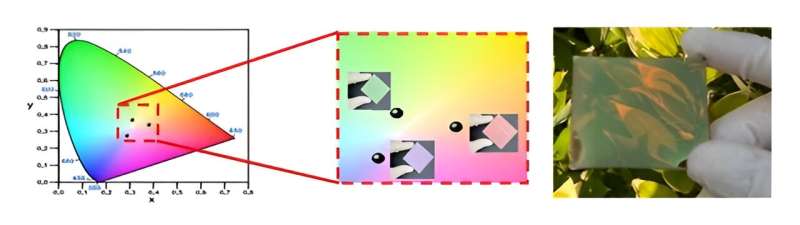
The research team formed multi-layer thin films with different refractive indices through periodic hydrogen reactions while depositing zinc oxide thin films using the vacuum sputtering deposition method used in general semiconductor and solar cell manufacturing processes. They then obtained the three primary colors of light by adjusting the thickness of the multi-layer thin film. At that time, the color of the electrode was well implemented even when applied to a solar cell that absorbs light in the visible light range.
The multi-layer transparent thin film electrode based on a single material does not require additional processing. It is expected that various colors and high efficiency of thin film solar cells can be realized at a low cost. In addition, since the reflective color is implemented as an optical filter, it can be applied to various fields such as image sensors, photolithography masks, and infrared shielding.
Dr. Jung-dae Kwon, a principal researcher, said, “When commercialized, this technology will help to develop simple and process-free light filter technology and high-efficiency colored flexible substrate transparent thin-film solar cells, as well as to realize BIPV systems for modern buildings and VIPV systems for vehicles with aesthetic features.”
This research was carried out under the basic research project of the Korea Institute of Materials Science and the energy technology development project of the Korea Institute of Energy Technology Evaluation and Planning. Based on this research, the research team is actively conducting follow-up research in the field of solar modules that express colors considering both the aesthetic and practical aspects of BIPV.
More information:
Soo-Won Choi et al, Flexible multi-layered coloring transparent electrode composed of AZO–based materials, Chemical Engineering Journal (2023). DOI: 10.1016/j.cej.2023.145226
Provided by
National Research Council of Science & Technology
Read the full article here


