

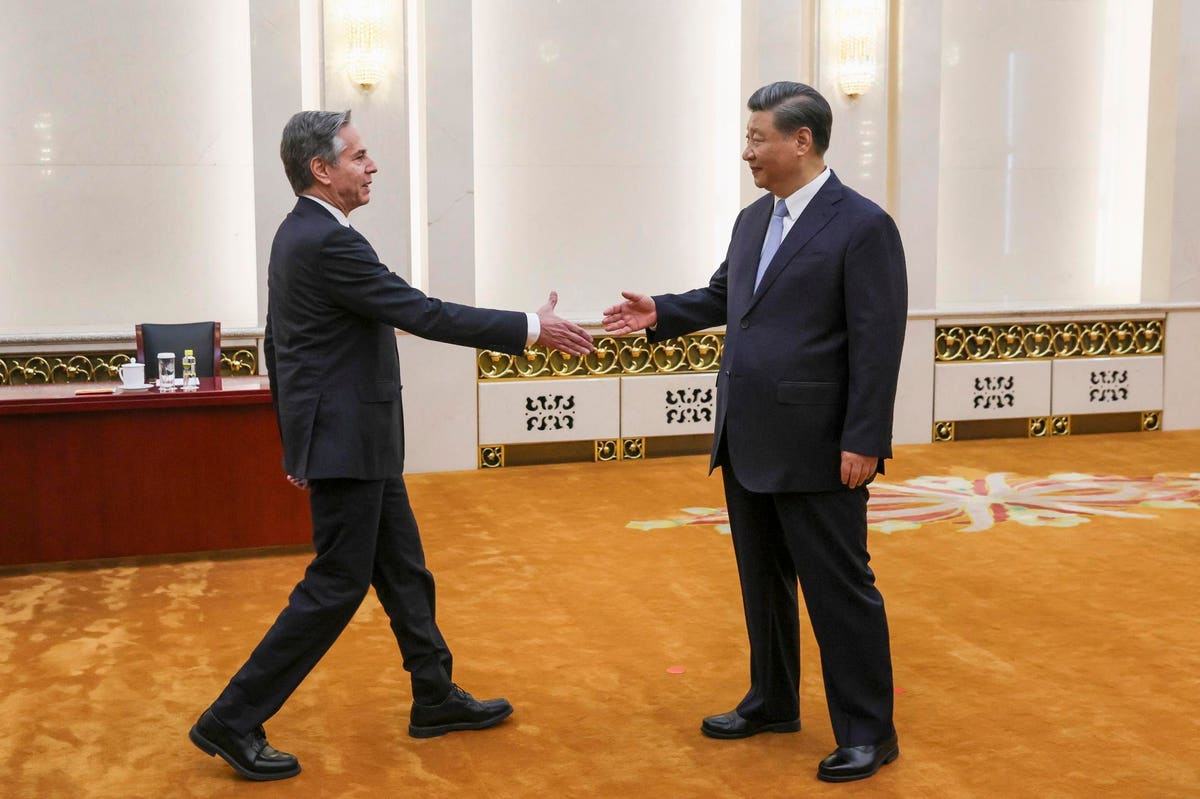
U.S. Secretary of State Antony Blinken in Beijing on Monday was able to get a much sought-after meeting with Chinese President Xi Jinping aimed at lowering a wide-range of tensions between two of the world’s most powerful economic and military powers.
The short length of the visit, however, suggested that the substance was largely perfunctory. “Diplomatic drive-by?” asked long-time Morgan Stanley Asia executive and current Yale Law School’s Paul Tsai Center China Center fellow Stephen Roach in a Tweet.
“Blinken-Xi met for only 35 minutes— one of the shortest high-level meetings on record. Consecutive translation cuts the actual exchange in half — leaving each less than 10 minutes of perfunctory speaking time,” Roach wrote.
Nonetheless, the meeting marked the highest level exchanges between the two governments since a pause earlier this year after the downing of a suspected Chinese spy balloon over the U.S. heartland in February created an uproar in Congress and set back momentum created by a meeting between President Biden and Xi in Bali last November.
Referring to the Biden-Xi meeting in Indonesia, a U.S. State Department spokesperson said today that “the two sides agreed to continue discussions on developing principles to guide the bilateral relationship, as discussed by President Biden and President Xi in Bali.”
Blinken’s meetings over two days with Xi, Director of the Communist Party Central Foreign Affairs Office Wang Yi, and State Councilor and Foreign Minister Qin Gang yielded “candid, substantive, and constructive discussions on key priorities in the bilateral relationship and on a range of global and regional issues,” the State Department’s Matthew Miller said in the statement.
Of particular interest to businesses, Blinken addressed China’s “unfair and nonmarket economic practices and recent actions against U.S. firms,” the statement said. “Recent actions” may have included raids on U.S. companies engaged in research and due diligence work including Bain and Mintz by Chinese security officials, stirring safety concerns among American executives; a new anti-espionage law to take effect on July 1 is also stoking worry. A shortage of U.S.-China flights, another burden for American companies doing business in mainland, was raised by Blinken.
Strains on business are also big problem for China this year as it tried to boost its economy amid youth unemployment of around 20%. Foreign investors have been partly taking their cue about putting money into the country from China’s own private sector businesses, whose new commitments have been hurt by worries about slow economic growth, left-leaning policies from Xi and geopolitical tension.
China’s new U.S. Ambassador Xie Feng also took to Twitter after the Xi-Blinken meeting, stating that President Xi “ believes the two major countries can overcome various difficulties and find the right way to get along based on mutual respect, peaceful coexistence and win-win cooperation.” That contrasted with harsher statements from Wang Yi. According to Xinhua News Agency, Wang “demanded that the United States stop playing up the so-called ‘China threat,’ lift illegal unilateral sanctions against China, stop suppressing China’s scientific and technological advances, and do not wantonly interfere in China’s internal affairs.”
Bliken said there had been no change in U.S. policy toward Taiwan – the self-governing democracy of 24 million over which Beijing claims sovereignty that is perhaps the biggest flashpoint between the two sides. The chief U.S. diplomat “underscored the importance of maintaining peace and stability across the Taiwan Strait and reiterated there has been no change to the U.S. one China policy,” the State Department said.
Taiwan’s relatively small size belies its importance to the global economy as one of the world’s most important semiconductor manufacturing centers; it is home to Taiwan Semiconductor Manufacturing, or TSMC, whose long list of U.S. customers include Nvidia and Intel. Blinken during his visit also brought up the Ukraine, another source of tension in U.S.-China ties due to China’s close relationship with Russia.
On a more positive note, the representatives of the two countries welcomed people-to-people exchanges, according to the State Department. “Both sides welcomed strengthening people-to-people exchanges between students, scholars, and business,” it said. U.S. business leaders to travel to China in recent weeks include Bill Gates, Elon Musk and Jamie Dimon. The two sides also agreed during the Blinken visit to work together on climate change, global macroeconomic stability, food security, public health, and counter-narcotics.
Blinken Tweeted pictures of meetings during his visit with exchange students there, part of a deluge of social media comments from around the world about the meeting.
Looking ahead, both sides agreed to “follow-on senior engagements in Washington and Beijing to continue open lines of communication,” the State Department said. Blinken invited Foreign Minister Qin – most recently China’s ambassador to the U.S. — to the U.S. to continue the discussions, and “they agreed to schedule a reciprocal visit at a mutually suitable time.”
Former U.S. diplomats speaking on the basis of anonmity this month said a Xi-Blinken meeting could help pave the way for a Xi visit to a meeting of APEC leaders in San Francisco in November. Blinken earlier this month concluded a trip to Saudi Arabia, where members of the Gulf Cooperation Council later gathered to express warm support of Arab-China business amid a big push by Beijing to expand its ties to that region.
See related posts:
Arab-China Investment, Manufacturing Poised To Grow After High-Profile Event In Riyadh
Gates Foundation To Donate $50 Million To Flight Infectious Disease, Partner With Beijing, Tsinghua
China’s “Fits And Starts” Economy Needs Private Sector Boost — Matthews Asia’s Andy Rothman
Forbes China Global 2000: China’s Ranks Thin As Real Estate Woes Persist
Elon Musk Visit To Beijing Highlights Business Role In U.S.-China Ties
@rflannerychina
Read the full article here