

Close Menu
  • Home
  • News
  • Startups
  • Innovation
  • Industry
  • Business
  • Green Innovations
  • Venture Capital
  • Market Data
    • Economic Calendar
    • Stocks
    • Commodities
    • Crypto
    • Forex
Facebook X (Twitter) Instagram
[gtranslate]
Facebook X (Twitter) Instagram YouTube
Innovation & Industry
Banner
  • Home
  • News
  • Startups
  • Innovation
  • Industry
  • Business
  • Green Innovations
  • Venture Capital
  • Market Data
    • Economic Calendar
    • Stocks
    • Commodities
    • Crypto
    • Forex
Login
Innovation & Industry
Green Innovations

Weakly-solvating electrolyte enables ultralow temperature (-80°C) and high-power CFx/Li primary batteries

News RoomNews RoomAugust 23, 2023No Comments2 Mins Read
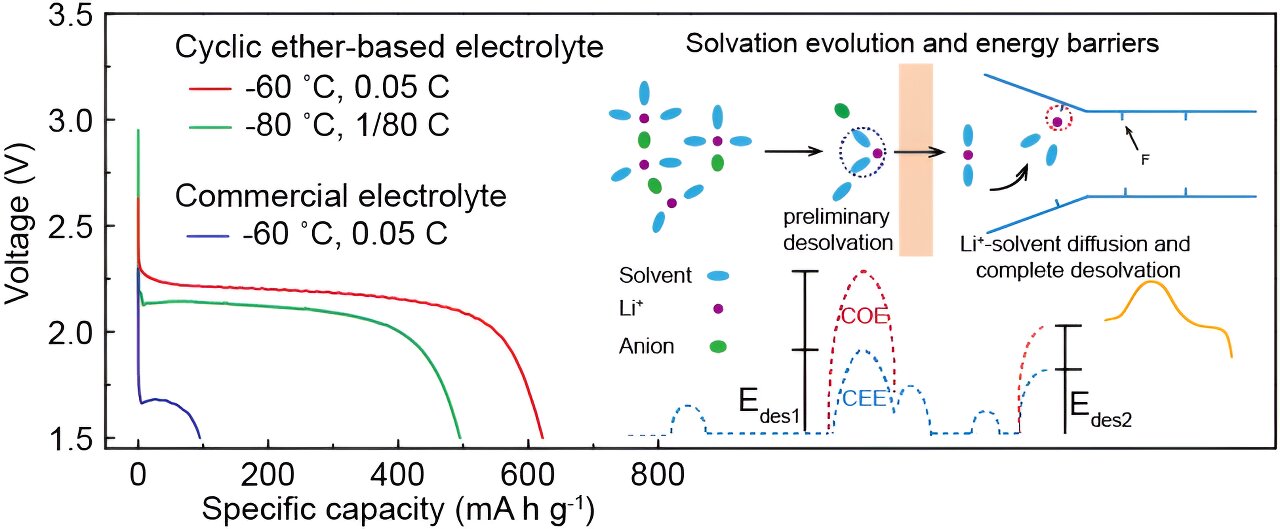
The weakly solvating cyclic ether-based electrolyte significantly facilitates overall reaction dynamics closely correlated to lower desolvation barrier, achieving ultralow temperature adaptability up to -80 °C. Credit: Science China Press

In a study published in the journal Science China Chemistry, researchers show how by selecting low melting point solvents and suitable salts and precisely tailoring Li+-coordinated environment via integration of low-affinity solvents with moderate anions, the weakly solvating cyclic ether-based electrolyte is introduced to significantly decrease desolvation activation energies and facilitate reaction kinetics, which are proved by molecular dynamics and binding energy calculation.

Discharged until 1.5V cut-off voltage, the assembled CFx/Li batteries yield 723, 652, and 495 mA h g-1 provided with average output voltages of 2.26, 2.22, and 2.11 V at -40, -60, and -80 °C, corresponding to energy densities of 1634, 1447 and 1044 W h kg-1, the best performances among current organic liquid electrolyte to the best of the researchers’ knowledge.

The higher capacity retention up to 82 % is produced at a discharge rate of 15 C (25°C). To further test potential for practical applications, the assembled CFx/Li cells with high load increased to 18-22 mg cm-2 still show energy densities of 1683 and 1395 W h kg-1 at -40 and -60˚C

With this work, researchers have proposed a powerful strategy for electrolyte modification with cost-effectiveness and practical scalability, which has unexploited application value and favorable exploitation foreground for an ultralow-temperature primary battery

More information:
Hao-Jie Liang et al, Weakly-solvating electrolytes enable ultralow-temperature (−80 °C) and high-power CFx/Li primary batteries, Science China Chemistry (2023). DOI: 10.1007/s11426-023-1638-0

Provided by
Science China Press


Read the full article here

Related Articles

Neutron scattering study points the way to more powerful lithium batteries

Green Innovations April 16, 2024

Researchers can help shipowners achieve ambitious climate targets

Green Innovations April 16, 2024

Solar energy can uplift rural Ethiopians, but is hard to come by

Green Innovations April 16, 2024

A timer can shorten your shower even when you have no incentive to save water

Green Innovations April 16, 2024

High electric bills threaten California’s clean future: This plan could help

Green Innovations April 16, 2024

New insight about the working principles of bipolar membranes could guide future fuel cell design

Green Innovations April 16, 2024
Add A Comment
Leave A Reply Cancel Reply

Copyright © 2026. Innovation & Industry. All Rights Reserved.
  • Privacy Policy
  • Terms of use
  • Press Release
  • Advertise
  • Contact

Type above and press Enter to search. Press Esc to cancel.

Sign In or Register

Welcome Back!

Login to your account below.

Lost password?