


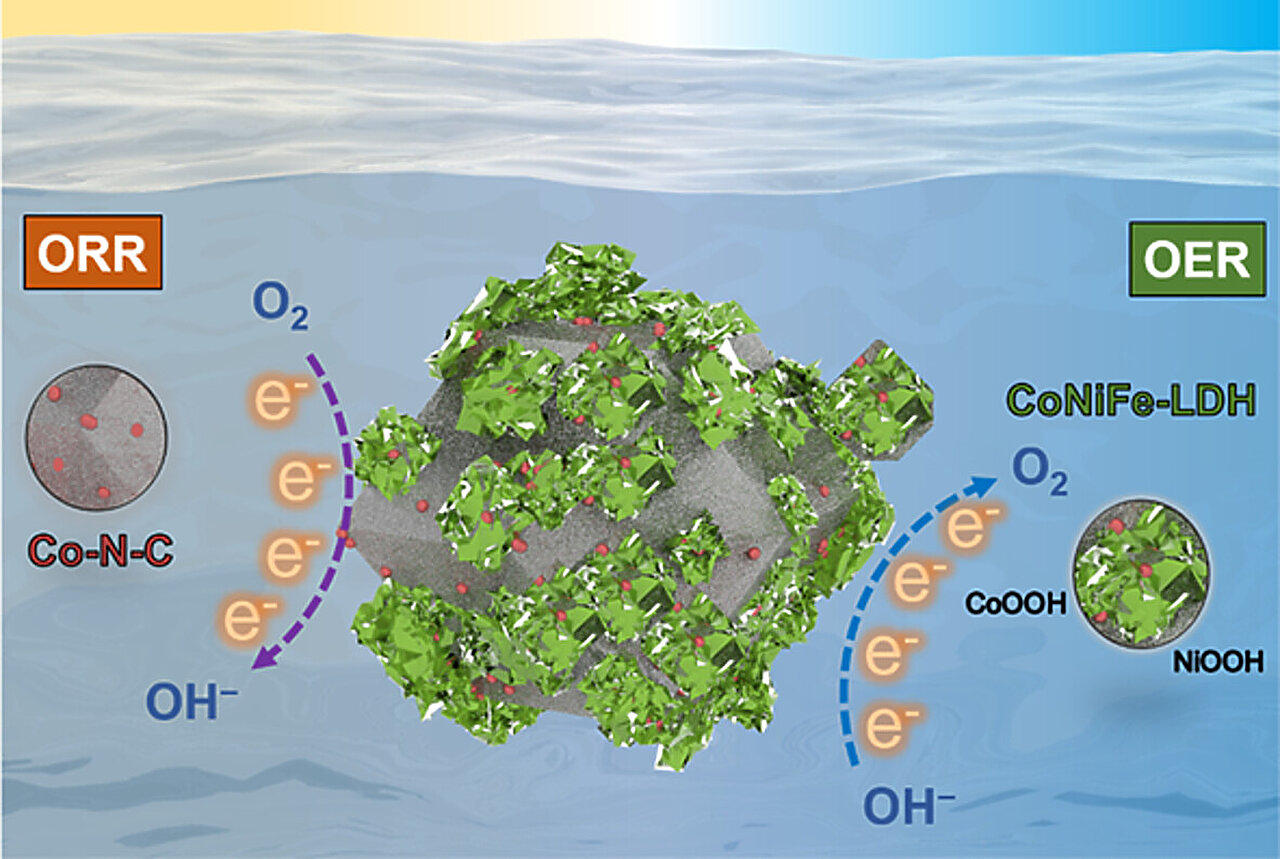
Zinc-air batteries have emerged as a better alternative to lithium in a recent Edith Cowan University (ECU) study into the advancement of sustainable battery systems.
ECU’s Dr. Muhammad Rizwan Azhar led the project which discovered lithium-ion batteries, although a popular choice for electric vehicles around the world, face limitations related to cost, finite resources, and safety concerns. The work is published in the journal EcoMat.
“Rechargeable zinc-air batteries (ZABs) are becoming more appealing because of their low cost, environmental friendliness, high theoretical energy density, and inherent safety,” Dr. Muhammad Rizwan Azhar said.
“With the emergence of next-generation long-range vehicles and electric aircraft in the market, there is an increasing need for safer, more cost-effective, and high-performance battery systems that can surpass the capabilities of lithium-ion batteries.”
Zinc-air: An explainer
A zinc–air battery consists of a zinc negative electrode and an air positive electrode.
The major disadvantage of these has been the limited power output, due to poor performance of air electrodes and short lifespan—until now.
ECU’s breakthrough has enabled engineers to use a combination of new materials, such as carbon, cheaper iron and cobalt based minerals to redesign zinc-air batteries.
“The new design has been so efficient it suppressed the internal resistance of batteries, and their voltage was close to the theoretical voltage which resulted in a high peak power density and ultra-long stability,” Dr. Azhar said.
“In addition to revolutionizing the energy storage industry, this breakthrough contributes significantly to building a sustainable society, reducing our reliance on fossil fuels, and mitigating environmental impacts.”
“By using natural resources, such as zinc from Australia and air, this further enhances the cost-effectiveness and viability of these innovative zinc-air batteries for the future.”
Viable and reliable
Dr. Azhar said while renewable resources such as solar, wind, and hydro energy play a critical role in the future of green energy, they are not completely reliable solutions as they are intermittent sources of energy.
“Due to the abundance of zinc available in countries such as Australia, and the ubiquity of air, this becomes a highly viable and reliable energy storage solution,” Dr. Azhar explained.
ECU’s re-design of zinc-air batteries brings Australia closer to achieving the UN sustainable development goals and targets set by the Paris Agreement, which was established in late 2015 to emphasize the need for sustainable energy resources to limit climate change.
More information:
Yasir Arafat et al, CoNiFe‐layered double hydroxide decorated Co‐N‐C network as a robust bi‐functional oxygen electrocatalyst for zinc‐air batteries, EcoMat (2023). DOI: 10.1002/eom2.12394
Edith Cowan University
Read the full article here


