


By 2050 North Africa could become a leading exporter of green hydrogen with Europe its main market, according to a recent report projecting the future of an industry still in its infancy.
So-called green hydrogen is set “to redraw the global energy and resource map as early as 2030, creating a $1.4 trillion-a-year market by 2050,” according to the report from accounting consultancy Deloitte.
Hydrogen fuel—which can be produced from natural gas, biomass or nuclear power—is considered “green” when hydrogen molecules are split from water using electricity derived from renewables such as solar and wind that do not produce carbon emissions.
Less than one percent of the world’s hydrogen production presently qualifies as green.
But the climate crisis—coupled with both private and public investment—has sparked rapid growth in the sector.
The Hydrogen Council, a lobbying group, lists more than a thousand hydrogen projects in the pipeline worldwide.
Projects launched before 2030 would require about $320 billion dollars in investment, the Council said.
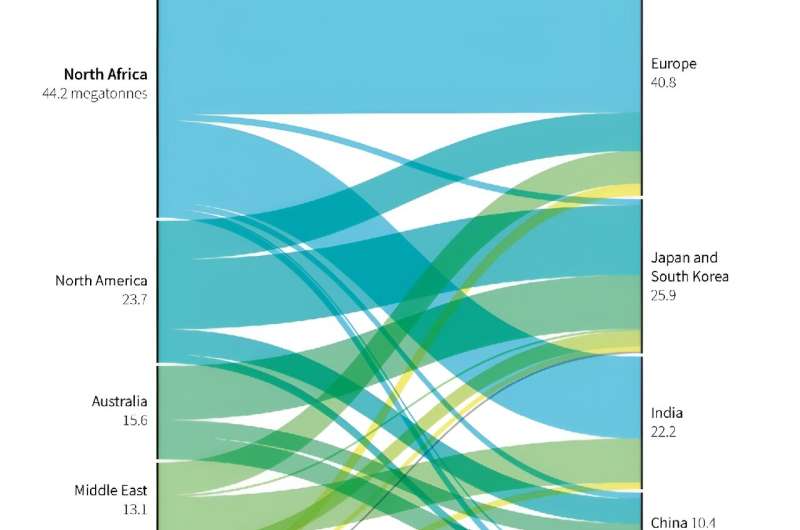
By 2050, according to Deloitte, the main green hydrogen exporters are likely to be North Africa ($110 billion per year), North America ($63 billion), Australia ($39 billion) and the Middle East ($20 billion).
Management consultancy reports can be assumed to heavily reflect the financial interests of their corporate clients, including some of the world’s largest carbon polluters.
But the need to meet climate targets and generous subsides are driving demand for clean energy of all kinds, including green hydrogen.
Long-haul aviation and shipping industries—for which the type of electric batteries powering road vehicles is not an option—are also keen on hydrogen as an alternative to fossil fuels.
Moroccan Sun and wind
The emergence of a clean hydrogen market from solar and wind could also make the industry more inclusive of developing countries, says the report.
It would also allow Global South steel industries, for example, to leapfrog past coal.
For now, however, 99 percent of the global production remains “gray,” meaning that hydrogen is produced by splitting methane molecules, which releases greenhouse gases no matter what kind of energy drives the process.
Truly green hydrogen releases hydrogen from carbon-free water molecules (H20) using an electrical current from a renewable source.
This is where Northern Africa may have a major role to play, says Sebastien Douguet, director of the Deloitte Energy and Modelling team and co-author of the report, which is based on International Energy Agency (IEA) data.
“We’re seeing that a number of North African countries such as Morocco or Egypt are taking up the hydrogen issue, and that ‘hydrogen strategies’ are being announced there just a few years behind the European Union and the United States,” Douguet told AFP.
“Morocco has very strong potential for wind energy that is often overlooked, and a great potential for solar power, and Egypt has the means to become the principal exporter of hydrogen to Europe in 2050 thanks to an existing natural gas pipeline” which could be adapted to transport hydrogen, he said.
Saudi Arabia also benefits from sunbaked and available land with the potential to produce 39 million tons of low-cost green hydrogen in 2050—four times its domestic demand—that would help diversify its economy away from petroleum, according to the report.
The report predicts investment will end by 2040 for carbon capture and storage as a solution to the emissions of methane-based hydrogen, which is the current strategy of the oil-rich Gulf States, as well as the United States, Norway and Canada.
Hydrogen produced this way is not be labeled green, but rather “blue”.
© 2023 AFP
Read the full article here


