


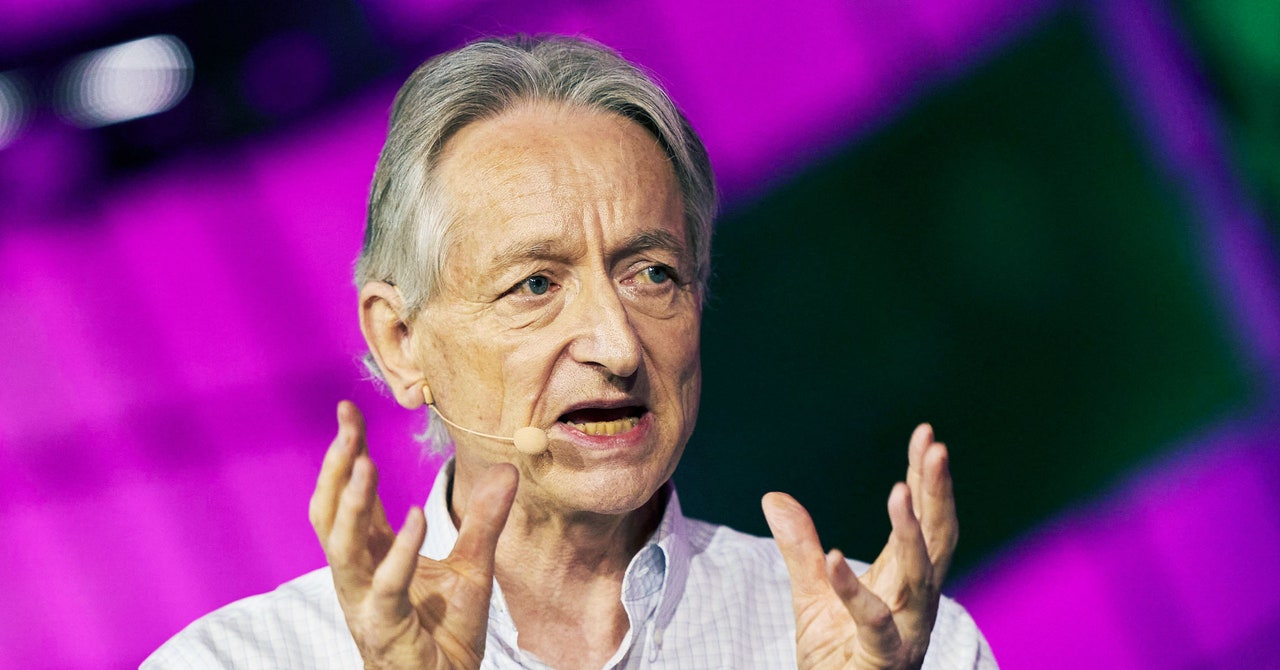
Geoffrey Hinton, perhaps the world’s most celebrated artificial intelligence researcher, made a big splash a few months ago when he publicly revealed that he’d left Google so he could speak frankly about the dangers of the technology he helped develop. His announcement did not come out of the blue. Late 2022 was all about the heady discovery of what AI could do for us. In 2023, even as we GPT’d and Bing chat-ed, the giddiness was washed down with a panic cocktail of existential angst. So it wasn’t a total shock that the man known as the “Godfather of AI” would share his own thoughtful reservations. Hinton took pains to say that his critique was not a criticism of the search giant that had employed him for a decade; his departure simply avoided any potential tensions that come from critiquing a technology that your company is aggressively deploying.
Hinton’s basic message was that AI could potentially get out of control, to the detriment of humanity. In the first few weeks after he went public, he gave a number of interviews, including with WIRED’s own Will Knight, about those fears, which he had come to feel only relatively recently, after seeing the power of large language models like that behind OpenAI’s ChatGPT.
I had my own conversation with Hinton earlier this summer, after he had some time to reflect on his post-Google life and mission. We talked about the doom scenarios, of course, but I was more interested in what made him change his mind about our potential AI future. Most of all, I wanted to know what he thought that LLMs were doing that could make them into foes of Team Human. The fears Hinton is now expressing are quite a shift from the previous time we spoke, in 2014. Back then, he was talking about how deep learning would help Google do more effective translation, improve speech recognition, and more accurately identify the address numbers on houses shown on Google Maps. Only at the end of the conversation did he take a more expansive view, saying that he felt that deep learning would undergo a major revamp that would lead to deeper understanding of the real world.
His prediction was correct, but in our recent conversation, Hinton was still marveling about exactly how it happened. Eventually our conversation took a turn toward more philosophical realms. What was actually happening when a system like Google’s Bard chatbot answered my question? And do LLMs really represent, as some people claim, the antecedent of alien form of superintelligence?
Hinton says his mind changed when he realized three things: Chatbots did seem to understand language very well. Since a model’s every new learning could be duplicated and transferred to previous models, they could share knowledge with each other, much easier than brains, which can’t be directly interconnected. And machines now had better learning algorithms than humans. “I suddenly flipped in my view that the brain was better than those digital agents,” he says. “Already they know 1,000 times more than any one brain. So in terms of massive knowledge, they’re way better than the brain.”
Hinton believes that between five and 20 years from now there’s a 50 percent chance that AI systems will be smarter than us. I ask him how we’d know when that happened. “Good question,” he says. And he wouldn’t be surprised if a superintelligent AI system chose to keep its capabilities to itself. “Presumably it would have learned from human behavior not to tell us.”
Read the full article here





