


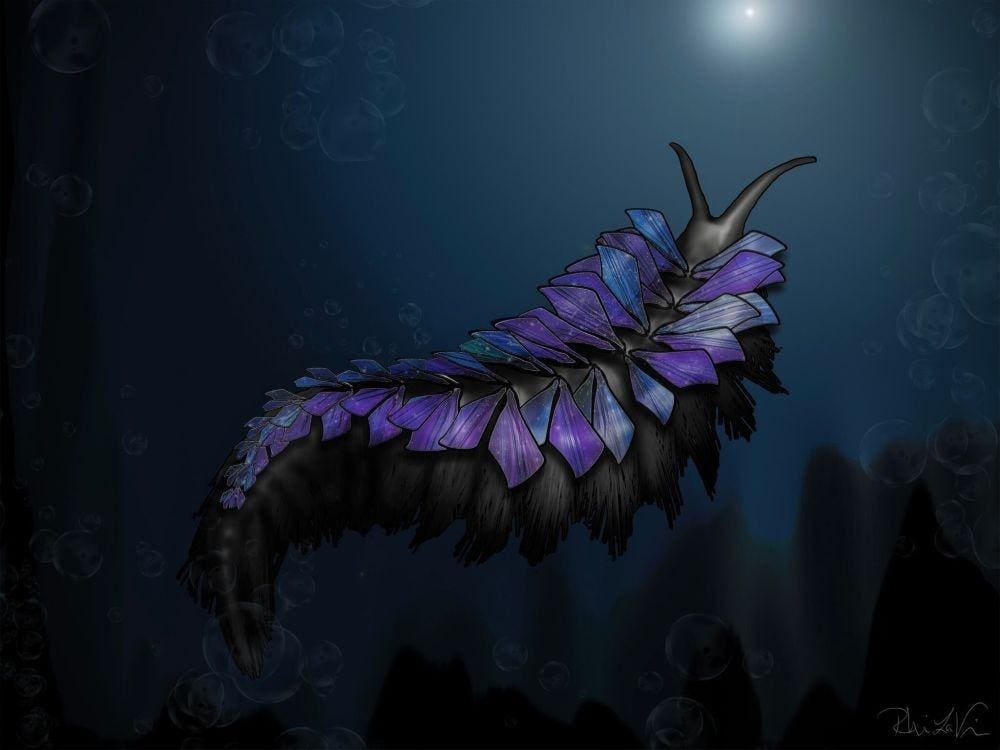
Rhiannon LaVine, a research associate with the University of Kansas, was part of a team camping and carrying out fieldwork in the High Creek area of the Spence Shale, a geologic formation straddling northern Utah and southern Idaho, when she split open a piece of rock discovering something strange.
Spence Shale is a fine-grained sediment deposited over 500 million years ago in a shallow sea. Paleontologists have described more than 90 species of trilobites and soft-bodied fossils since the discovery of this Cambrian Fossil-Lagerstätten.
But LaVine’s discovery didn’t match any other Cambrian critter known so far.
“I was showing it to everybody, asking, ‘What do you think this is?’ LaVine explains. “Nobody had an idea. We thought maybe it’s a Wiwaxia, a very peculiar animal from about that time—but we don’t have too many representatives of it from the Spence area. Or maybe it’s a scale worm, but there’s no real scale worms known from that time. Maybe it was a juvenile jellyfish, but it’s so bladed and the lines are so straight on those things, it would be kind of odd. So, I couldn’t get a solid answer.”
The researchers analyzed the peculiar specimen under a scanning electron microscope to study its structure and performed a chemical analysis to confirm it is indeed a fossil.
“We mainly wanted to make sure that this was a biological thing, because it’s possible it could have just been some weird mineral growth with the way it looked.”
Preserved as a thin film of iron-oxide the specimen represents the fossil cast of a worm-like, about 7 to 8 centimeters long animal. Noteworthy is a series of blade-like appendages running parallel along the sides.
Finally, LaVine and her co-authors were able to determine the fossil to be a previously unknown species of annelid, a diverse group of “segmented worms” that today include more than 21,000 species.
“Annelids are very rare in the Cambrian of North America, and so far we only knew of a single specimen from the Spence Shale,” explains study co-author Julien Kimmig, a paleontologist with the State Museum of Natural History in Karlsruhe, Germany.
Due to its origin in the alien world that was Cambrian Earth (some Cambrian organisms seem to have no modern relatives), LaVine bestowed the species with its scientific name: Shaihuludia shurikeni.
“It’s very cool to think about our planet as a record of history and all of the different environments that have happened over billions of years, all on the same ground we stand on. We’ve had alien worlds beneath our feet,” so LaVine. “It was the first thing that came to mind, because I’m a big ol’ nerd and at the time I was getting really excited for the ‘Dune’ movies.”
Shai-Hulud is the indigenous name for the colossal, worm-like creatures living on the desert-planet Arrakis. They first appear in the 1965 novel Dune by Frank Herbert. In the successful science-fiction saga, they are the only known source of the Spice, a psychoactive drug that allows humans to master space travel. The term”shuriken” is the Japanese word for throwing star, referring to the shape of the blade-like appendages (actually modified bristles or chaetae that characterize many modern annelids) of the new species.
“The new annelid Shaihuludia shurikeni is especially interesting, as it had some very impressive chaetae, which makes it unique among the Cambrian annelids. The way that the fossil is preserved is also of particular interest, because most of the soft tissue is preserved as an iron oxide ‘blob,’ suggesting the animal died and was decomposing for a while before it was fossilized. However, with the analytical methods used in the paper, we show that even with limited preservation you can identify fossils,” concludes Kimmig.
The study “Annelids from the Cambrian (Wuliuan Stage, Miaolingian) Spence Shale Lagerstätte of northern Utah, USA” was published in the journal Historical Biology (2023). Additional material and interviews provided by the University of Kansas.
Read the full article here



