


Current batteries are limited by their required charging time and achievable range. The US Department of Energy (DOE) developed a fast-charge goal of 10 minutes to charge an electric vehicle (EV) battery.
However, fast charging current Li-ion batteries can result in Li-metal plating of the carbon-anode and the potential formation of catastrophic lithium dendrite shorts. Li-metal anodes have the potential to overcome these issues, as rather than plating Li-metal being a problem, it is in fact the anode, and moreover Li-metal anodes enable higher energy density batteries and thus EV range. However, to date the charging rate of Li-metal anodes has remained limited by the formation of lithium dendrite shorts.
Dr. Eric Wachsman, director of the Maryland Energy Innovation Institute (MEI2) and Distinguished University Professor at the University of Maryland (UMD), and his research team developed a single-phase mixed ion- and electron-conducting (MIEC) garnet material which when integrated into their previously developed 3D architecture, not only achieved the DOE Fast-charge goal for Li cycling, but exceeded it by a factor of 10.
The porous structure of the MIEC garnet helps relieve the stresses on the solid electrolytes (SE) during cycling by spreading the potential uniformly across the surface, thus preventing local hot spots that could induce the formation of dendrites.
This transformative material and structure are a huge breakthrough that will be impactful for EVs and other applications. The paper, “Extreme Lithium-Metal Cycling Enabled by a Mixed-Ion-Electron-Conducting (MIEC) Garnet 3D-Architecture,” is published in Nature Materials.
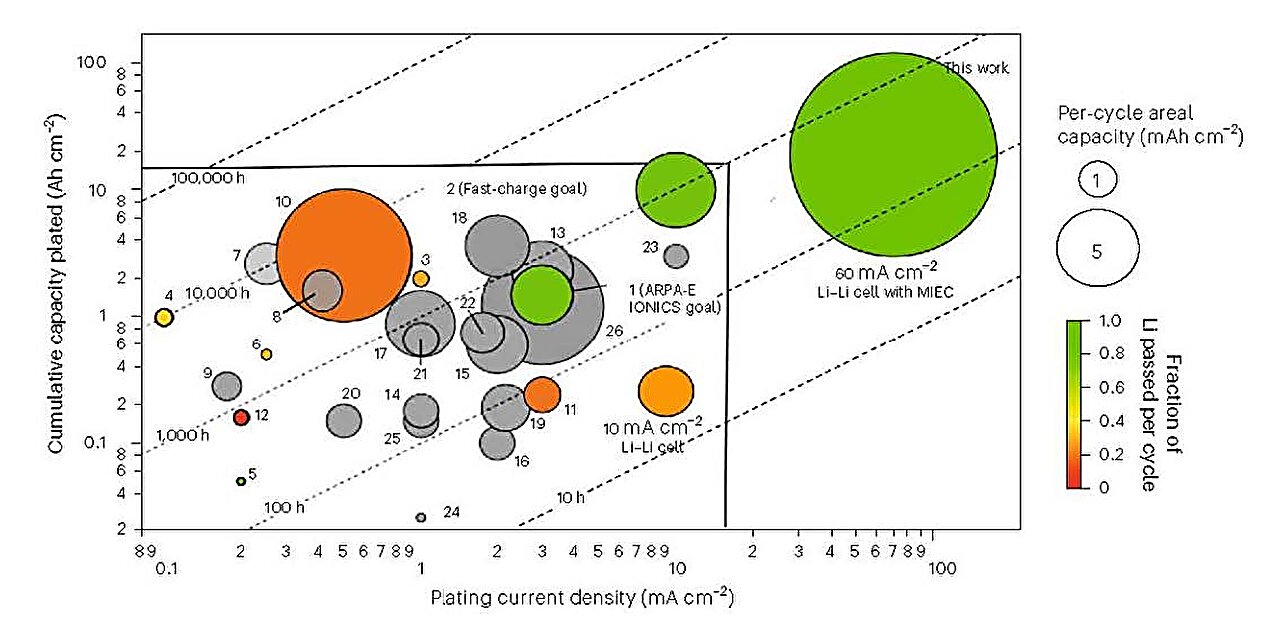
The Li cycling rates (X-axis), quantity of Li per cycle (circle diameter), and cumulative Li cycling (Y-axis) far exceed the DOE Fast Charge Goals for current density, per-cycle areal capacity, and cumulative capacity, at room temperature with NO applied pressure. With this Li cycling capability EVs would be able to do 100% depth of discharge cycles every single day for 10 years, far beyond any anticipated EV lifetime/warranty requirements.
Dr. Y. Shirley Meng, chief scientist, ACCESS Argonne National Lab and Professor in the Pritzker School of Molecular Engineering at the University of Chicago, said, “Wachsman and team demonstrated superior rate capability of lithium metal anode in this work, it is through innovative 3D design and the unique architecture such performance could be achieved. Such approach opens up a new paradigm for the design of next generation high energy rechargeable batteries.”
“In my 35 years of working on solid ion conducting materials this is the first time I’ve seen anywhere in the scientific literature the ability to cycle ions at room temperature across a solid ceramic at current densities as high as 100 mA/cm2, especially ions from a solid metal.” said Wachsman. The successful demonstration of this high-rate dendrite-free Li metal in 3D MIEC structures is expected to spur the development of practical “Li-free” anode solid-state batteries.
“The reversible high-rate lithium metal anode is one of the key challenges on the route to competitive solid-state batteries. Demonstration of current densities as high as reported by Eric Wachsman and his team may be a game changer,” said Dr. Jürgen Janek, Director Center for Materials Research, Justus Liebig University Giessen.
More information:
George V. Alexander et al, Extreme lithium-metal cycling enabled by a mixed ion- and electron-conducting garnet three-dimensional architecture, Nature Materials (2023). DOI: 10.1038/s41563-023-01627-9
University of Maryland
Read the full article here


